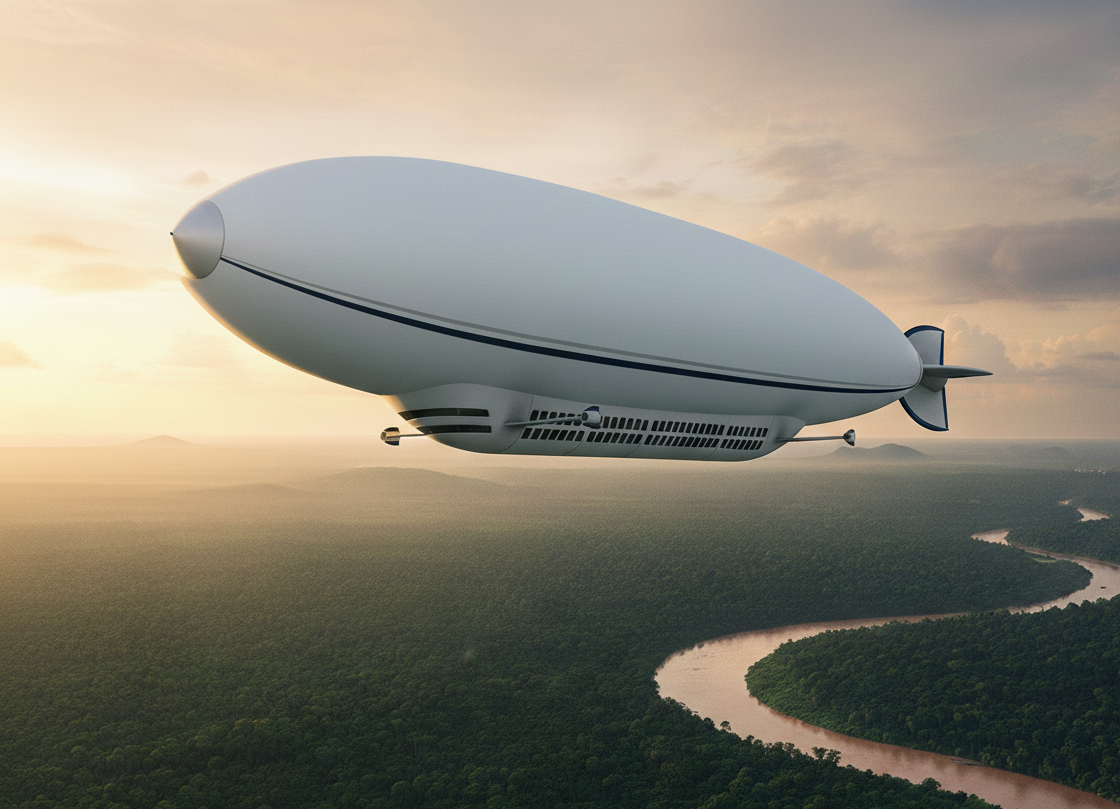
The Hércules is the new global benchmark for Super-Heavy logistics. Inspired by legendary aircraft such as Antonov, once the world’s reference for oversized missions and now unavailable — it emerges as the only aerial platform capable of replacing and surpassing its role.
With 210 tons of payload capacity and 21,000 m³ of cargo volume, it performs tasks that once required convoys, ports, railways, and months of planning. What traditionally took 230 days can now be completed in just 5.
As an Eternaus-class aircraft, the Hércules operates with continuous airborne autonomy, remaining in the sky for extended periods and performing missions without the need for runways or ground infrastructure. This unique capability enables uninterrupted operations and unprecedented logistical freedom.
With capacity for up to 1,400 passengers in ultra-first-class suites and individual or couple apartments, the Hércules can generate US$ 140 million per year (96 flights from New York to London, for example), operating with high energy efficiency and zero emissions.
The Hércules’ differential lies in its operational versatility. Equipped with integrated lifting systems — such as cranes or hoists — it can:
- Remove heavy or oversized industrial equipment such as turbines, transformers, mining machines, wind-energy modules, oil-platform components, silos, gas scrubbers, large tanks, etc., directly from the production site (e.g., Germany, Sweden, USA) and transport them by air to remote locations (e.g., hydroelectric plants in China, mines in Chile, frozen supplies in the poles, silos in deserts).
- Perform lifting and installation at any destination without external equipment, using only dynamic stabilizers and without the requirement of free access or heavy counterweights demanded by traditional cranes.
This makes Super-Heavy logistics extremely simple, fast, and economical — reducing, for example, 230 days to just 5 in the China hydroelectric scenario.
The Hércules can transport chemical waste charged at €3.50/kg for incineration (e.g., contaminated chromic acid) and carry it in polypropylene tanks from Frankfurt to the Sahara Desert in Libya or Egypt, where it can be buried and stored for future reprocessing and reuse as raw material.
210,000 kg × €3.50 = €735,000 per flight × 210 = €150 million/year
This creates a compelling business case for:
- Environmental-service companies
- Government contracts
- Industrial waste-management operators
- Private investors seeking high-margin missions
This represents only one of the many profitable applications enabled by the Hércules platform.
The Hércules is simultaneously:
- A super-heavy cargo aircraft
- A global industrial Lifter
- A remote-access installation platform
- A sustainable logistics solution
- A luxury airborne residence or yacht
It can be prepared and decorated as a luxurious flying palace with 5,600 m² across four decks with 2.5-meter ceilings, or as a majestic 180-meter (600-foot) airborne yacht, capable of fulfilling the most demanding dreams and desires of a very special clientele.
The Hércules is one of the most versatile and transformative aircraft ever conceived — a machine designed to reshape how logistics, trade, engineering, mining, tourism, agriculture, and industries build, expand, and connect across the planet, while remaining eternally in the sky as a true Eternaus.